It is difficult to take in how badly injured the children are. We are not used to this at home. That children are so badly hurt.
Roger Alcock
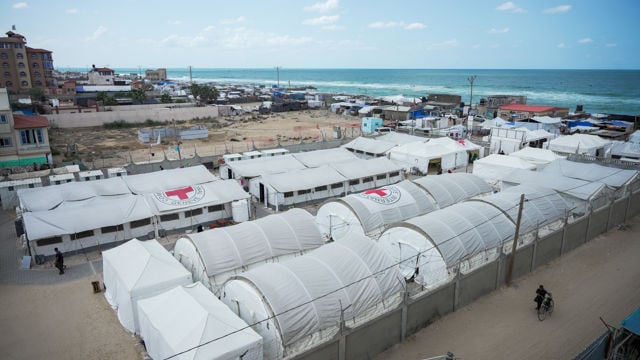
The Red Cross Field hospital in Rafah.
Red Cross doctor Roger Alcock has never seen so many injured people as in Gaza. At the field hospital in Rafah, they save lives and also create moments of joy for the children in the midst of the catastrophe.
– I have never seen so many injured people as I have in Gaza. Both before and after the ceasefire. In just one month, I saw more injured people, and more severe injuries, than I have seen in many years.
This is what Roger Alcock says. He is a doctor working for the Norwegian Red Cross. Alcock has practised medicine for 28 years and has spent the past 13 years working in disaster settings, including earthquakes and typhoons, armed conflict and outbreaks of infectious disease. In October, he worked at the Red Cross field hospital in Rafah, both before and after the ceasefire.
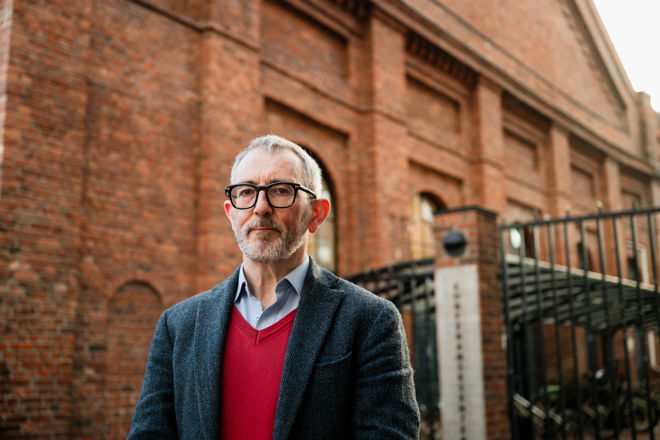
Roger Alcock works as a Senior Medical Adviser with the Red Cross (global emergency response)
– Many patients said they were shot while trying to obtain food, leaving some critically injured and others dying later in hospital. Before the ceasefire, explosions caused further severe injuries. Children and older people, women and men – ordinary people going about their daily lives have all been affected.
Roger Alcock speaks quietly and with focus about the horrors he witnessed and the extremely difficult conditions.
Most people are living in tents and under tarpaulins along the beach. In recent weeks there has been heavy rain and flooding. There are major problems related to sewage, very limited access to water, and difficulties in obtaining food, and what little food is available is extremely expensive. Alcock says conditions improved somewhat after the ceasefire, with fewer acute gunshot wounds and a less dangerous situation. However, people have lost a significant amount of weight, and children are much smaller than expected for their age.
– There is a huge need for wound care. Many people in Gaza have very severe wounds that require regular treatment. Adequate nutrition, particularly high-protein food, is essential for healing, alongside proper wound care and appropriate antibiotic treatment when infections occur.
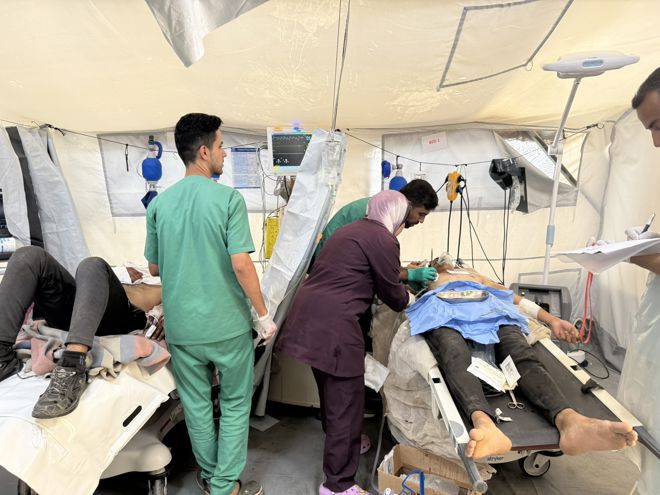
Field hospital in Rafah.
Before the ceasefire, people came to the hospital because they were hit by stray bullets — random gunfire while cooking or doing other daily tasks inside their tents. Children, older people, all kinds of people.
– When people cannot feel safe in what they call their home - which may be the twelfth place they have lived recently because they are constantly being internally displaced. What kind of world is that? asks Roger Alcock.
And the children. He describes children struggling simply to be children: six- and seven-year-olds dragging heavy cans of water, resting outside the hospital on their way back to their families with the large containers.
The Red Cross opened the field hospital in Rafah on 9 May 2024. Since its opening, the hospital has carried out approximately 180,000 consultations, performed more than 11,000 surgical procedures, and delivered more than 800 babies.
One day, clowns came to the hospital. You may wonder: Why have clowns at a hospital in Gaza?
– Yes. Children must be allowed to be children. During those hours when the clowns were performing magic tricks with the children, you could see the children being children, and the parents and adults enjoying it as well. It was a wonderful, brief respite in what is currently an incredibly difficult environment to live in.
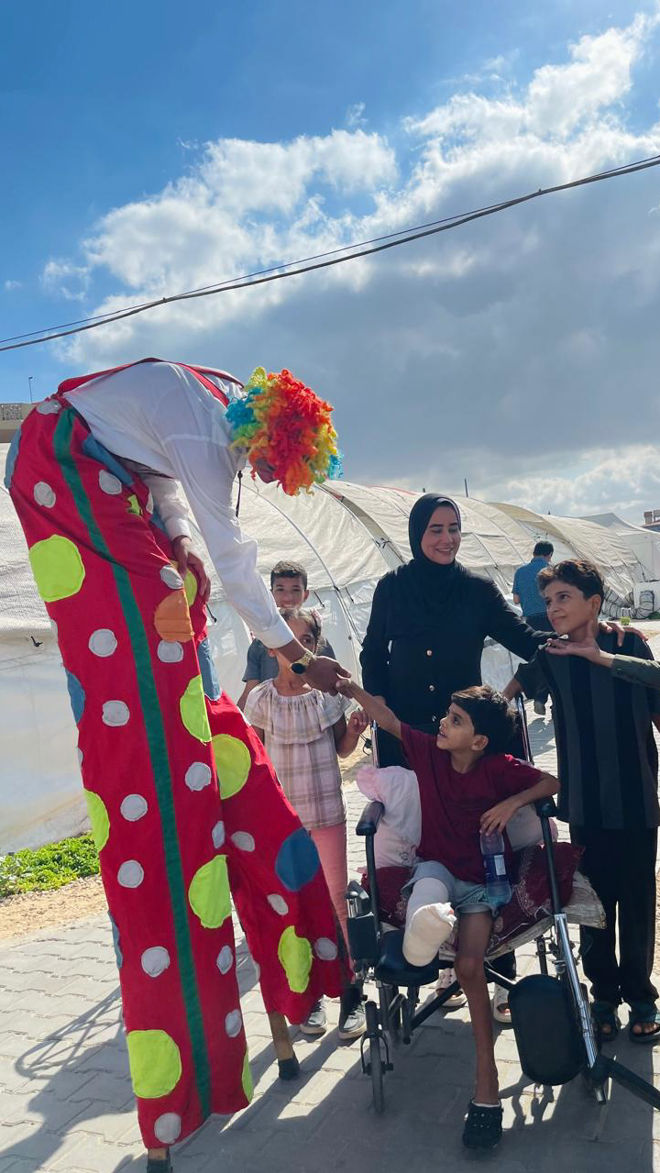
It is difficult to take in how badly injured the children are. We are not used to this at home. That children are so badly hurt.
Roger provides an example:
A child arrives at the hospital with severe gunshot wounds to the abdomen and groin. As a result, the child is bleeding internally and develops traumatic cardiac arrest. The child stops breathing because the heart also stops, because they did not have any blood in their circulation.
In this case, the Red Cross team managed to restart the child’s heart and breathing, administer blood, control the bleeding and resuscitate the child before transferring them to an appropriate facility. This would be challenging in any healthcare system, even in Norway or other European countries. In an emergency field hospital setting, it is even more difficult.
– I feel privileged and proud to have worked in a team capable of delivering this level of care, says Roger Alcock.
The field hospital, supported by Norway, had 60 beds when it opened. Before the ceasefire, it often had more than 120 inpatients, many with mass-casualty injuries – especially after GHF began food distribution not far away, during which several civilians were shot at the food stations.
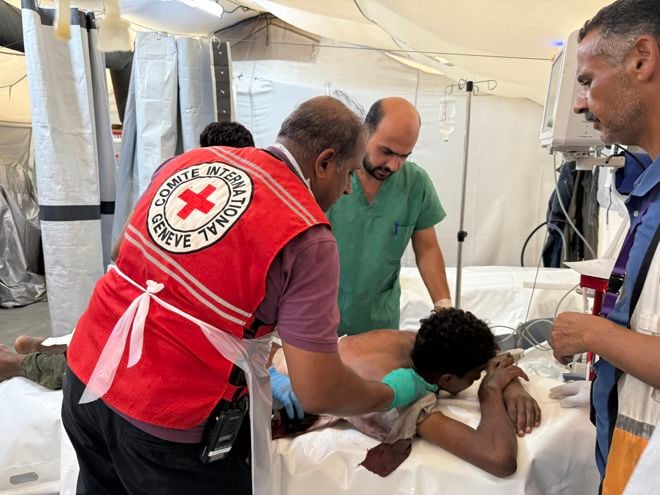
At the Red Cross field hospital in Rafah, doctors are saving lives.
According to UN figures, 3.3 million people are in need of humanitarian assistance in Palestine - Gaza, the West Bank and East Jerusalem. The entire population of Gaza, approximately 2.1 million people, is considered dependent on humanitarian aid.
Limited access and Israeli restrictions on humanitarian deliveries mean the UN has assessed Palestine’s needs at USD 4 billion for 2025, with USD 3.6 billion earmarked for Gaza and USD 454 million for the West Bank, including East Jerusalem.
Alcock also highlights the severe psychological strain. He describes how impressed he was by the volunteer team from the Palestine Red Crescent Society at the hospital, who provide psychosocial support and mental health care.
– Perhaps the best way to summarise this is with an example of a patient who, when I arrived, appeared to be close to death. He was cachecti, in other words severely undernourished, and required surgery twice a day because of his condition. It began with a gunshot wound to the abdomen, which led to a serious infection. But in addition to the physical problems, it was clear that this boy – because he was a young boy – had lost hope and no longer wanted to live. He often cried out and screamed at night, which distressed staff, other patients and relatives.
Watch the video interview with Roger Alcock.
The team made a great effort to help him. They tried using a health app on a mobile phone, talked to him, but what worked best was giving him a colouring book. The teenager began to draw and colour.
– When I left after a month, the boy who had seemed ready to give up was walking around the ward – still limping, but on his feet greeting you with a fist bump as you passed by. It’s incredible. A truly remarkable example – and there are many more such stories, Alcock says.
The Rafah hospital has had limited medicines, water, fuel and other essential supplies, and health workers have had to ration and improvise to continue their work.
The needs are still very great. The Red Cross field hospital in Rafah is the only facility in the area, with no other health services available.
In 2024, Norway contributed NOK 1.05 billion in humanitarian aid to Palestine and Palestinian refugees in neighbouring countries. Total Norwegian aid reached NOK 1.7 billion.
In 2025, Norway is increasing its support further following the budget agreement between the Labour Party, the Socialist Left Party, the Centre Party, the Red Party and the Green Party. On 22 December, the Storting (the Norwegian Parliament) approved an additional NOK 1 billion, bringing Norway’s total support to Palestine this year to NOK 2.1 billion.
Read the press release on regjeringen.no (only available in Norwegian).
The additional billion now approved, will be distributed between the humanitarian budget, which will receive NOK 601.7 million, and the regional allocation for the Middle East, which will receive NOK 400 million. The aim is to strengthen both emergency assistance and long-term efforts at a time when the situation is uncertain and can change from minute to minute.
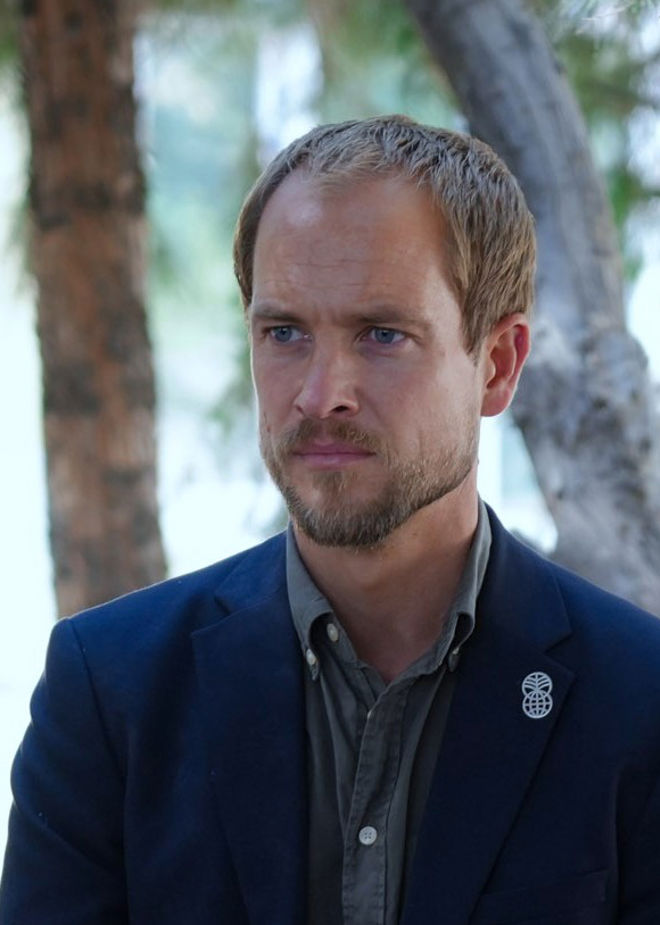
The situation for people in Gaza remains extremely critical, despite the ceasefire.
Norway also chairs the Ad Hoc Liaison Committee (AHLC) for Palestine and has a strong tradition of both long-term support and emergency aid.
– The ceasefire has made it possible to bring in more emergency assistance, but it is far from sufficient to meet the acute needs. Through the UN and partners such as the Red Cross, Norway is providing support. Winter is now approaching, bringing enormous needs for people who are cold and lack even the most basic necessities. It is also important to remember that hostilities continue and that people are still being killed, says Erik Abild, Director of the Department for Humanitarian Assistance and Comprehensive Response at Norad.
What will happen in the near future is unclear because the situation is highly unstable and can change from minute to minute.
– From a health-care perspective, the reality is that Gaza right now has an –enormous need for medical assistance. With support from WHO, authorities have made plans to improve and scale up health services, Alcock summarises.
– I truly hope that we will be able to support, and continue to support, our colleagues and the local community in Gaza so that they can regain the quality of life they deserve: that they can be safe, have enough food, access health care, receive an education and live a normal life. I truly hope this is possible and that we can help make it happen, says experienced doctor Roger Alcock.