Norwegians fear more wars: – Prevention is the answer
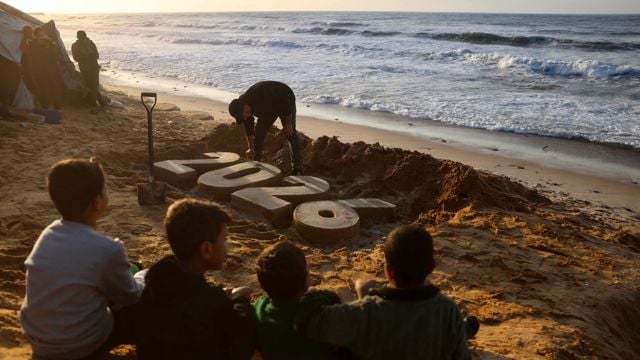
Children watch as artist Yazed Abo Jarad creates a sand sculpture of the coming year, while displaced Palestinians prepare to mark the New Year in Deir al-Balah in central Gaza on December 30, 2025.
Three out of four Norwegians are concerned about war and conflict, and more than half believe the world will experience more wars over the next three years, according to a new population survey. The Norad Conference 2026 highlights the need to increase investment in development assistance for conflict prevention.
Watch the recordings of the sessions from the conference.
– Peacebuilding and conflict prevention save lives, reduce human suffering and are more cost-effective than rebuilding after war. Development assistance and long-term development cooperation can potentially play a larger and more important role in this area, says Norad Director General Gunn Jorid Roset.
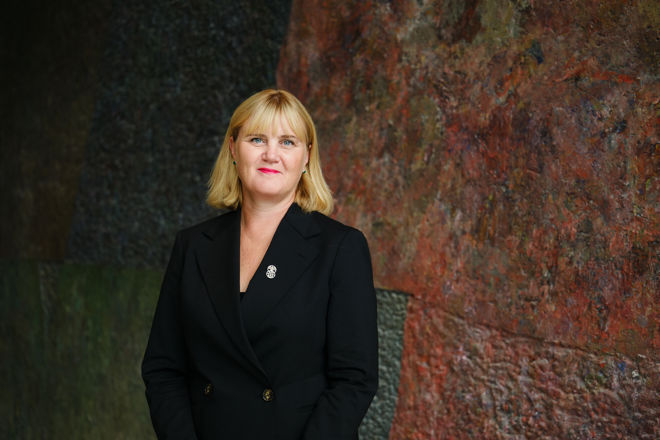
Norad Director General Gunn Jorid Roset.
Not since the Second World War have there been more conflicts in the world than today – with record numbers of people displaced, increasing levels of violence against civilians, and conflicts lasting for ever longer periods.
A long-term investment in peace
At the turn of the year, 239 million people were in need of acute humanitarian assistance and protection. At the same time, 831 million people – one in six globally – were exposed to conflict over the past year, according to recent figures.
– Poverty fuels conflict, and conflict fuels poverty. Addressing the drivers of violence and conflict – such as poverty, hunger, inequality and injustice – is a long-term investment in peace. This is not only a moral responsibility, but also a matter of using resources wisely, says the Norad Director General.
War and conflict prevention are also key themes of the Norad Conference 2026, which today (28 January) brings together leading voices from around the world at Sentrum Scene in Oslo to discuss how international development cooperation and development assistance can contribute to a more peaceful world.
Watch the recording of the conference
We must not lose hope
The population survey conducted in connection with the conference was carried out among a representative sample of 1,200 Norwegians. Respondents answered questions related to eight international crises. These are some of the findings:
- Three in four (76 per cent) Norwegians are concerned about war and conflict. Women and older people are particularly worried.
- More than half (55 per cent) believe the world will see more wars/conflicts over the next three years.
- Seven in ten believe Norway should strengthen its military defence capability, given the current international security context. Among those over 60, 83 per cent think Norway should build up its defences, compared with 57 per cent among young people under 29.
- 85 per cent say international co‑operation is important for resolving war and conflict.
- Women are generally more worried than men.
- Young people are concerned about war and conflict, but climate change and the extinction of species are also major concerns for many youths.
Keynote speech by Gunn Jorid Roset, Director General in Norad
See the full survey (Only in Norwegian)
For Norad, the findings of the population survey are a clear reminder that Norwegians recognise the seriousness of the situation – and expect action, emphasises Norad Director Gunn Jorid Roset.
– Norwegians are concerned, and with good reason. However, we must not lose hope. Hope is essential to endure – and to act. Building peace means addressing the root causes of conflict, she says.
Cost-effective development assistance
UN High Commissioner for Human Rights Volker Türk, Sudanese democracy activist Alaa Salah (known as “Lady Liberty”), war correspondents, humanitarian workers, peace activists, politicians and leading conflict researchers from around the world are among those taking the stage at today’s Norad Conference, held under the title “Peace Out?”.
The backdrop to the conference is bleak. More than 240,000 people worldwide have been killed in conflict-related violence over the past 12 months. Over 117 million people have been forcibly displaced and one in five children globally live in, or are fleeing from, conflict zones, according to recent figures from the Global Humanitarian Overview and ACLED’s conflict index.
Conflicts are also becoming more brutal: 90 per cent of those affected by explosive weapons in urban areas are civilians, and the use of drones in warfare has increased by 4,000 per cent since 2020.
– War is development in reverse. When development assistance is cut at the same time as humanitarian needs are rising, our ability to prevent suffering and promote peaceful and sustainable development worldwide is weakened. This is why Norway maintains a high level of development assistance, stresses Norad Director Gunn Jorid Roset.
This message is reinforced by a new report from the Peace Research Institute Oslo (PRIO), which is also being presented at Norad Conference on 28 January. The report concludes that long-term development assistance can make a significant contribution to addressing the structural drivers of violence and conflict. Preventing conflict is also far more cost-effective than attempting to rebuild societies in the aftermath of war, the report shows.
Facts and figures on war, conflict and humanitarian need
- Between 2021 and 2024, armed conflicts resulted in an estimated 740,000 battle-related deaths.
- In 2024 alone, 61 state-based conflicts were recorded in 36 countries – the highest number since 1946.
- At the beginning of 2026, more than 239 million people are in acute need of humanitarian assistance and protection, due to protracted conflicts.
- At least 56,000 civilians were killed in conflict between January and mid-October 2025.
- Civilians account for 90 per cent of those affected by explosive weapons in populated areas.
- One in six people – an estimated 831 million, or 16 per cent of the world’s population – were exposed to conflict during 2025.
- Around 520 million children – more than one in five children globally – live in or are displaced from conflict-affected areas. Explosive weapons are killing children on an unprecedented scale, as wars are increasingly fought in urban areas and grave violations against children are rising.
- More than 117 million people have been forcibly displaced due to conflict and violence, including 42.5 million refugees. Sudan remains the world’s largest displacement crisis.
- The use of drones is making conflicts more accessible and increasingly asymmetric. Between 2022 and 2024, the number of companies producing drones rose from six to more than 200. Drone strikes in conflict areas increased by 4,000 per cent between 2020 and 2024.
- The duration of conflicts has nearly doubled over the past 30 years. In 1990, conflicts lasted an average of 16 years; by 2020, the average duration exceeded 30 years.
- War and violence also carry an enormous economic cost. In 2023, conflict cost the world nearly USD 20 trillion – more than 13 per cent of global GDP, or an estimated USD 2,380 per person.
- To put this into perspective: the per capita cost of violence exceeds the average annual income per person in Africa.
- In summary: conflicts are more violent towards civilians, last longer and cost more than at any time since the Second World War.
(Sources: PRIO, Global Humanitarian Overview 2026, ACLED, Global Peace Index)
For more information, please contact Head of Press Nina Bull Jørgensen, mobile: +47 99705615 and/or e‑mail: nb.jorgensen@gmail.com